
HYROX Cardiff 2026
What My First HYROX Taught Me About Mental Performance
Graham
5/5/20265 min read
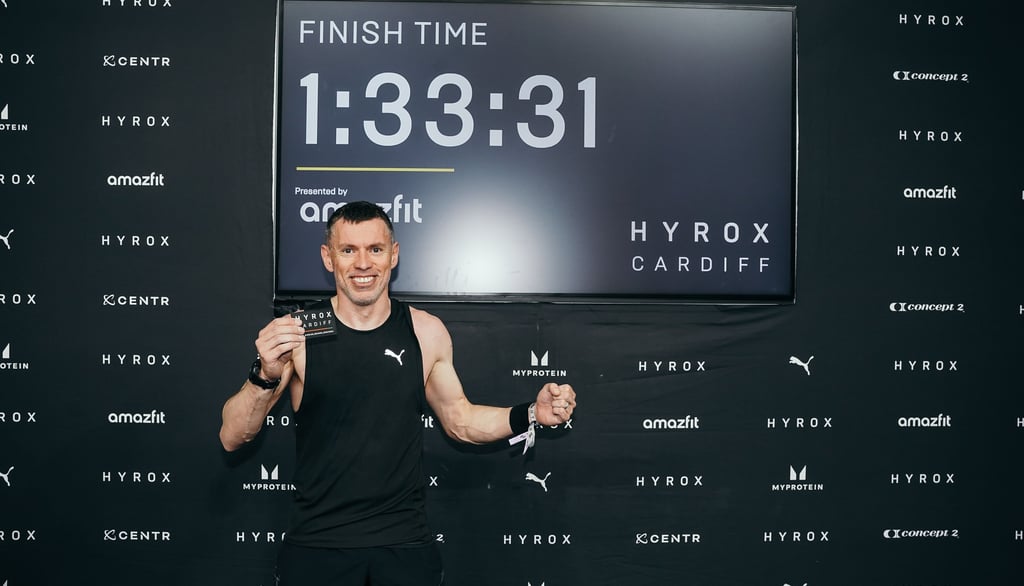
Last week, I stood in the tunnel at the Principality Stadium in Cardiff, waiting to start my first-ever HYROX. Heart rate rising. Noise building. Body buzzing.
I loved the event! Brilliant atmosphere, excellent organisation and a true mental and physical test. Over the years I've been lucky to be able to compete in loads of big events - Marathons, ultras and Ironman, for example, but haven't done so for a good few years. One thing I definitely realised was that I'd missed it. The build-up, the anticipation and the buzz of event day itself.
Here’s a short blog about the experience, split into 2 parts. Firstly, a run-through of how the event went, and secondly, the mental performance tools I used to help me execute my best on the day.
If you haven't come across Hyrox before, then this video gives a good introduction.
This blog isn’t about heroics or chasing podiums. It’s about what it took mentally to show up, compete well, and enjoy the experience, especially when things weren’t ideal going in.
My HYROX Journey
First time in the arena
HYROX Cardiff was my first experience of hybrid fitness racing. I raced in the Men’s Solo, finishing in 1:33:30. A time that’s not going to challenge for any podiums, but a solid result, and one I’m genuinely happy with.
The context matters, though.
I hadn’t run seriously for around two years before entering. Most of that time had been focused on Brazilian Jiu-Jitsu, not endurance racing. On top of that, I’ve been managing a hip labral tear, which meant training and racing had to be approached intelligently rather than aggressively.
Load management wasn’t optional. It was the whole game.
Preparing with constraints, not excuses
Training became an exercise in honesty. What can I do consistently without flaring up my hip? Where do I need to be cautious? And how do I race hard without tipping over the edge?
That meant:
Being conservative with running volume
Accepting that movements like wall balls were a potential risk for my hip
Making peace with not “emptying the tank” on every session
Making sure to plan in recovery, and treat it as a key part of my training
Race week and race day
I travelled down to Cardiff the day before. I like to arrive early, see the venue, and let the environment become familiar. That small step removes a lot of unnecessary stress.
After checking out the Principality Stadium, I kept things simple—early night, feet up in the hotel, watching Arsenal vs Atlético Madrid. Nothing fancy. Just calm.
Because it was midweek and the kids were at school, I was flying solo. It would have been great to have the family there, but it also meant one less variable to manage.
My wave was at 9:40am, so I arrived at the venue just after 7am, watched a couple of earlier races, and went through a relaxed warm-up. The organisation was excellent, and the atmosphere struck a really good balance—energising without being overwhelming.
When it was time, I stepped into the tunnel.
I paced the race well. In hindsight, I probably had more to give on the runs and machines (ski and row), but I deliberately held back to protect the hip, especially heading into the wall balls. Burpees and lunges, on the other hand, felt strong and controlled.
Mental Performance Tools I Used
Everything below is personal. These tools worked for me, in this context. Other athletes may need different approaches, and that’s exactly how it should be.
1. Visualisation: rehearsing the unfamiliar
In the weeks before the race, I spent time mentally running the entire event.
Not just the highlights, but the logistics as well.
How many laps was each run?
Where did I turn?
What did the transition into each station look like?
Cardiff was notoriously confusing in places. But because I’d already “done the race” multiple times in my head, nothing felt new on the day. Familiarity breeds calm.
I’d visualise:
Slowing my breathing
Relaxing the body
Then calmly moving through the race, station by station
On race day, it felt surprisingly familiar.
2. Breathing to regulate the moment
Just before the start, in the tunnel, I used a physiological sigh—a double inhale followed by a long, slow exhale.
This wasn’t about hype or firing myself up. It was about stopping my heart rate from going through the roof too early and bringing my attention back into my body.
Calm first. Performance follows.
3. Self-talk: practised, not improvised
Good self-talk doesn’t magically appear on race day. It needs rehearsal.
Weeks in advance, I practised phrases I knew would resonate when things got uncomfortable:
“You can do hard things.”
“This is what you do.”
Simple. Familiar. Supportive.
When the discomfort arrived, as it always does, I didn’t have to search for motivation. I’d already packed it. Without having practised, productive self-talk to fall back on, it's easy to let negative thoughts come in, and that's when performance can really suffer.
4. Technique cues under fatigue
As fatigue builds, technique can fall apart. Simple cues become gold.
Mine were short and functional:
SkiErg: Easy
Sled push: Drive
Sled pull: Reach long
Farmer’s carry: Suck it up
Lunges: Embrace the suck
Each cue brought my focus back to what mattered right now, rather than how tired I felt.
5. If–Then planning: removing surprises
Before race day, I asked:
What might go wrong?
What will I do when it does?
If energy levels dropped – Take an extra gel
If the hip barked – Take a quick stretch, and then adjust pace if needed
If I missed an A goal - Then commit fully to the B goal.
When issues came up, there was no panic. I already had a response.
6. Nutrition: decided early, practised often
Nothing new on race day. Ever.
I’d already decided:
What I’d take
When I’d take it
How it fitted around stations
And I practised it in training until it felt automatic.
Cognitive load saved is energy preserved.
7. Goal setting that keeps you moving forward
I set A, B, and C goals:
A goal: 1:30 (everything perfect)
B goal: 1:35 (solid, well-executed race)
C goal: Finish strong and stay healthy
When the A goal slipped away, the race didn’t unravel. The B goal kept me pushing with purpose.
In training, I also separated goals into:
Outcome goals (Enjoy 1st Hyrox, finishing with a time I could be proud of)
Performance goals (Time, pacing, splits, heart rate)
Process goals (Training plan, execution, mental skills, nutrition, recovery)
Final thoughts
HYROX Cardiff wasn’t just a physical event for me, it was a chance to practise what I coach.
Not chasing perfection.
Not forcing outcomes.
But showing up present, prepared, and able to deliver my best when it mattered.
High performance doesn’t come from trying to control the result.
It comes from managing the manageable and accepting the rest.
That’s true in sport, and everywhere else.
If you’re preparing for a big performance, competition, or challenge of your own, and want to explore how mental skills can support that journey, feel free to get in touch.
Performance begins within.
Graham